Córdoba has one of the richest and most interesting histories in the world. A cradle of civilizations and a meeting point for different cultures, this ancient city has much to offer.
Hundreds, thousands of years of history await to be discovered, and to truly understand its richness, there are certain places and monuments you simply must visit, no excuses.
At first, it may seem like a lot, and you may not know where to start, but that’s why we’re here. So grab your most comfortable sneakers and get ready for the adventure that Córdoba has in store for you.
The Best and Main Monuments in Córdoba
There’s plenty to choose from, because after so many years of history, it’s hard to know where to start, but we’re going to give you a list of the most essential and important things to see in Córdoba.
It’s a basic list to prevent your smart-aleck friend from not responding when you tell him you’ve visited Córdoba, “And haven’t you been to…?” Yes, yes, you’ve been, of course you have. Let’s all work together to avoid giving him the satisfaction of being right. Let’s explore the most important monuments in Córdoba.
The Mosque of Córdoba
When we talk about Córdoba, the first thing that immediately comes to mind is the Mosque of Córdoba. You’ve heard so much about it and have surely seen thousands of images, but let me tell you, that’s nothing compared to reality.
It’s a must-see, no matter how much time you spend here in Córdoba, the Mosque is a must-see. And if you’ve heard something about a Cathedral and are a bit lost, don’t worry, the rumours are true; it’s actually the Mosque-Cathedral of Córdoba. The Cathedral was built inside—you read that right—the Mosque because the beauty of the original building was so great that they didn’t want to touch anything.
A UNESCO World Heritage Site since 1984, it boasts a wide mix of architectural styles: Gothic, Renaissance, Umayyad, and Baroque. Inside, it houses more than 1,200 columns and arches, as well as original elements like its minaret.
The Alcázar of the Christian Monarchs
We continue talking about heavyweights of history, architecture, and Córdoba, in this case the Alcázar of the Christian Monarchs. This was used as a Royal Palace for many years, and Romans, Visigoths, Arabs, and Christians passed through here.
Perhaps the most famous owners were the Catholic Monarchs, who lived there for years, mainly before the reconquest of Granada. You have to see everything about the Alcázar of the Christian Monarchs: its interior, its exterior, its towers and gardens; you can’t miss anything.
It lost some of its strength and influence during the Caliphate, as the first Caliph, Abd al-Rahman III, moved his residence, political headquarters, and palace to Medina Azahara. What is Medina Azahara? Read on because it’s another of our highlights.
Medina Azahara
Declared a World Heritage Site by UNESCO in 2018, it is a city steeped in legends, stories, and mysteries. It is not located, like the previous monuments, in the historic center of Córdoba, but at the beginning of the Sierra Morena, about eight kilometers away.
It was Abd al-Rahman III who ordered the construction of this walled city, demonstrating the power of the new Independent Caliphate of the West. It was something like flexing its muscles internationally, saying: look how strong I am, watch how I do what I want.
To give you a rough idea of what Median Azahara was like, I can tell you that it was a walled city, divided into three terraces, dividing the city into different areas. Here everything was powerful, rich materials like marble and gold, luxurious craftsmanship by the best stonemasons and artisans.
The future and continuous wars of Al-Andalus left in ruins what was once one of the strongest cities of the most powerful empire in the world.
Synagogue of Córdoba
This 14th-century religious building is the only synagogue you can visit in all of Andalusia. It’s a historic building that was used for various purposes after the expulsion of the Jews from Córdoba. Its state of preservation is spectacular, and you can’t leave without visiting the women’s gallery, the ablutions area, the courtyard, and the prayer hall.
Roman Bridge
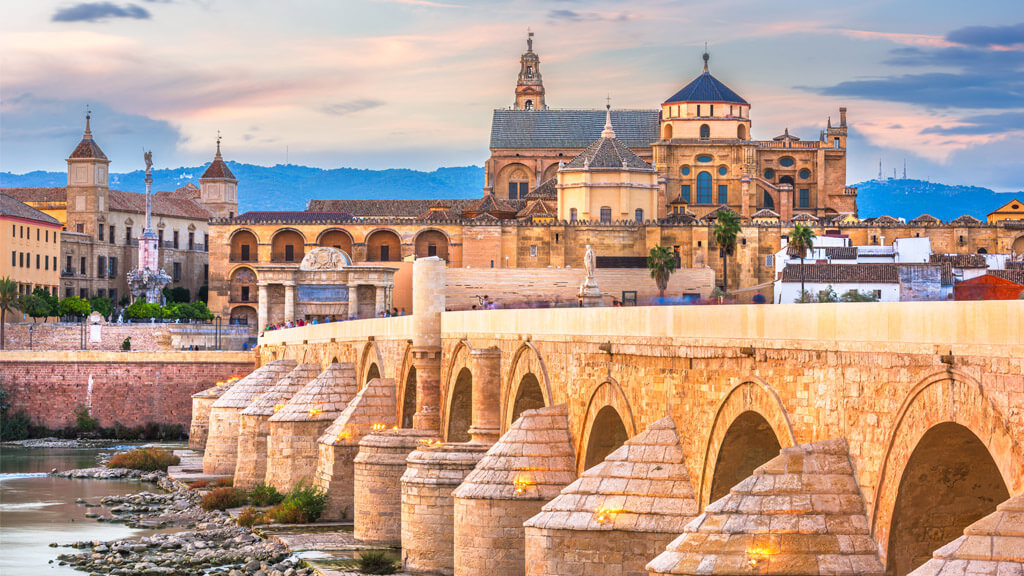
The original bridge dates back to the 1st century BC, but it has undergone numerous renovations, which have kept it so well preserved that it can continue to be used. To give you an idea, the main structure dates from the medieval period, and the last major renovation took place in 1876.
Its most characteristic elements are its sixteen arches, both semicircular and pointed, the 16th-century sculpture of Saint Raphael, and the Puerta del Puente (Bridge Gate). This gate is one of the three historic gates that remain in good condition in the city of Córdoba, the other two being the Almodóvar Gate and the Seville Gate.
Due to its proximity and history, visits to the Mosque-Cathedral, the river, the Puente del Puente, and the Roman Bridge of Córdoba are often done together, something we recommend you do as well.
Calahorra Tower
Crossing the bridge, leaving the Mosque and the entire historic centre of Córdoba behind, you will find the Calahorra Tower. This tower was a defensive element at the foot of the city’s foundations hundreds of years ago. Now it’s a museum about the medieval period and how the three cultures of the time coexisted: Muslim, Jewish, and Christian.
Viana Palace
This 14th-century palace-house will play a bit with your senses. At first, upon seeing it, you may think it’s not that great, that maybe we’ve gone too far by including it on the list of important monuments. But how wrong you are.
The Viana Palace is beautiful inside, out, and in every way. No matter how you look at it, the interior tour is guided, although you can freely wander through the courtyards. And if the interior is beautiful, the courtyards are its highlight. Twelve Andalusian-style courtyards filled with flowers and beautiful corners. The tour lasts about two hours, and after touring the entire palace, you’ll have no doubt why it’s on our list.
Mudejar Chapel of San Bartolomé
The Mudejar Chapel of San Bartolomé is one of the most charming places in the Jewish Quarter of Córdoba. The Jewish Quarter is the neighbourhood around the Mosque, and one of the areas with the most history and beauty in all of Córdoba.
Within the Jewish Quarter, this chapel is one of the jewels in the crown, although it is also one of the least known. Although it is not very large, it actually has a side length of about nine meters. Built in the 14th century, it looks like it was built last week, judging by how well-preserved the plasterwork and tiles are.
Royal Stables
One of Córdoba’s great prides is its Royal Stables, which were commissioned by Philip II in 1572. His dream came true, and the best horses from around the world were bred here; Cordoban and Arabian horses, primarily for military use.
It is currently used for the equestrian show “Pasión y Duende del Caballo Andaluz,” although you can also include a guide to all the stables in your tour.
The Roman Temple
We arrive at what is the only remaining building from the Roman period. It dates from the 1st century AD and is located near the Plaza de la Corredera, another important place to visit, and Córdoba City Hall. The Temple preserves six columns at the front and ten columns on the sides.
About Me / Sobre Mi

CATS Hostels en una cadena española de hostels con 4 alojamientos en la península ibérica: Madrid, San Sebastián, Córdoba y Oporto. Nuestra misión es ofrecer un lugar de descanso con un alto grado de socialización a todos aquellos viajeros que buscan un lugar cómodo a precio asequible para experimentar ciudades como un local más.